Product Introduction:
Wuhan UHV Power Technology Co.,Ltd., is a professional manufacturer and supplier of high-voltage power testing equipment in China.The Cable Identification Instrument is specifically designed for power cable engineers and field workers to solve the technical challenges associated with accurate cable identification. This instrument enables users to reliably identify a target cable from a group of multiple cables, preventing serious accidents caused by mistakenly cutting live cables.
Cable identification requires coordinated operation at both ends of the cable, and the numbering at both ends must be verified for accuracy. This instrument utilizes advanced PSK technology to ensure precision and reliability. No matter how reliable the memory of field personnel may be, it cannot substitute the certainty provided by a professional instrument.
Important: This product is intended solely for the on-site identification of power cables that have been de-energized and disconnected. It is strictly prohibited to connect this cable identification device to any live or operating power cable.
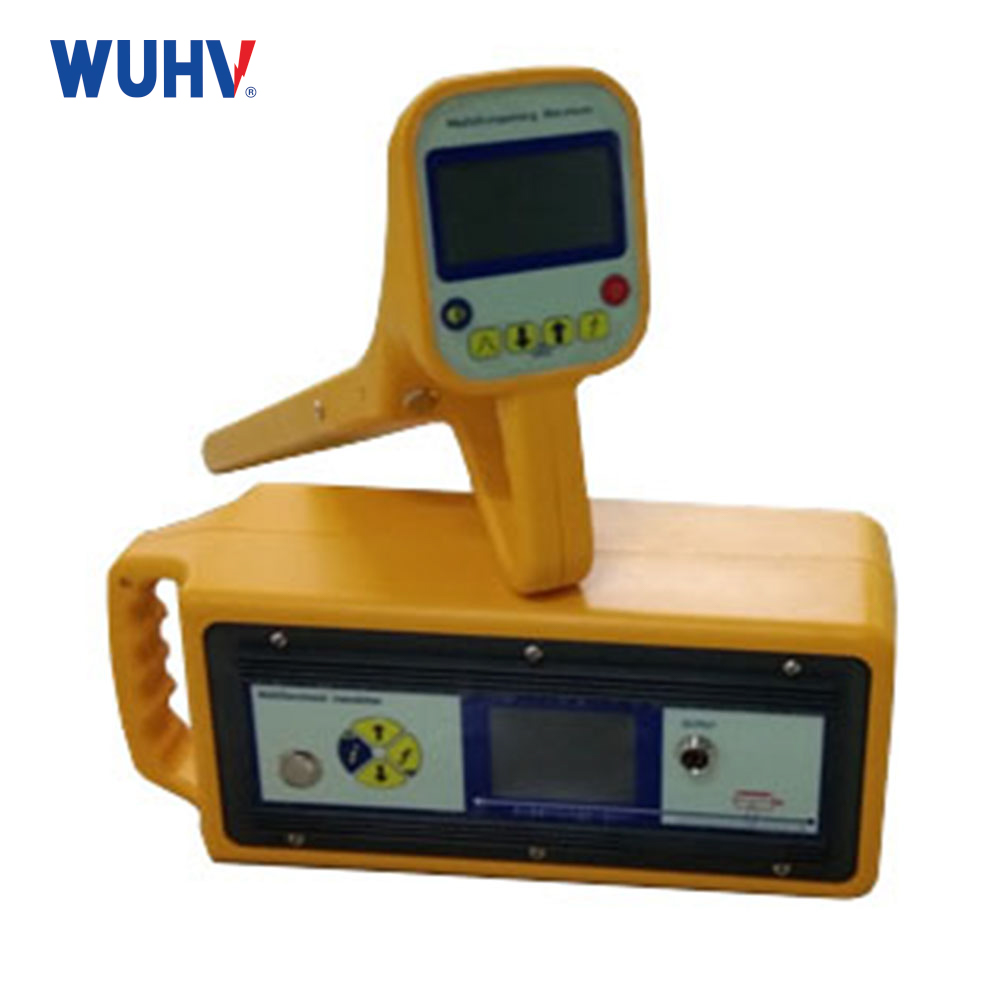
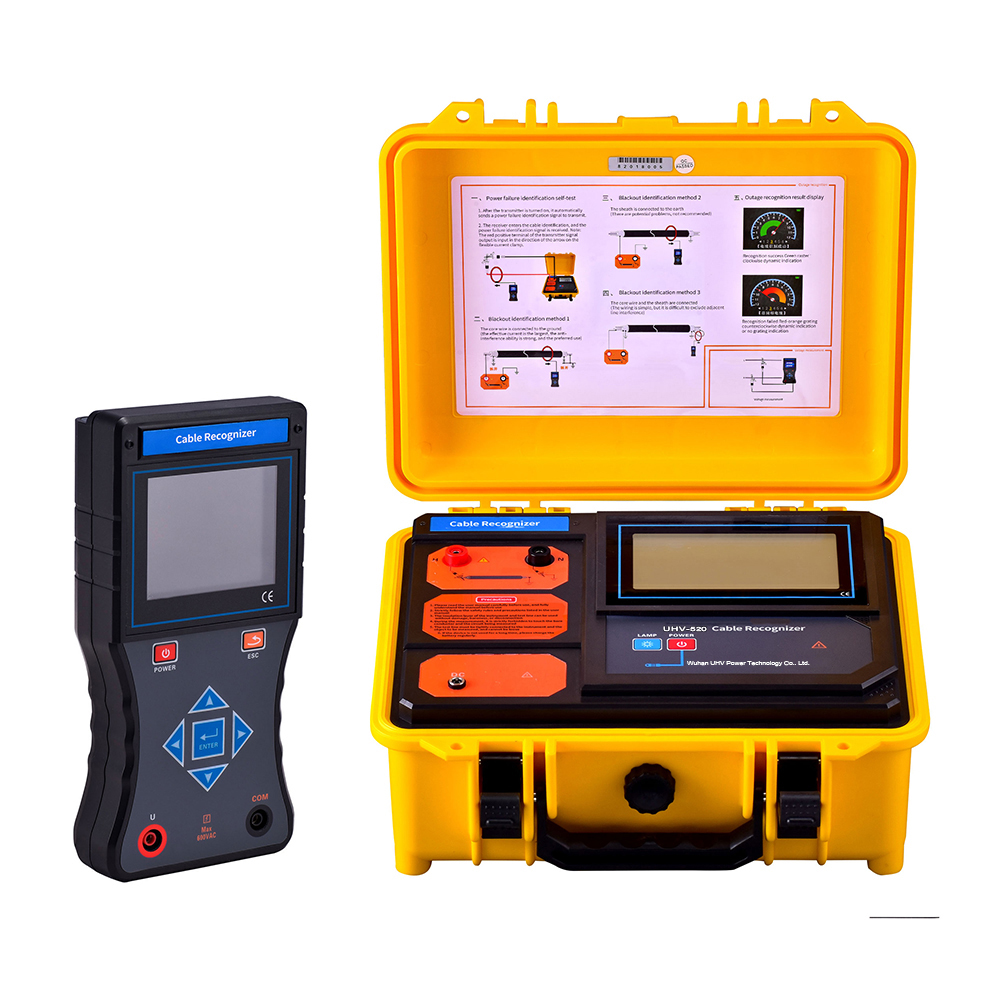
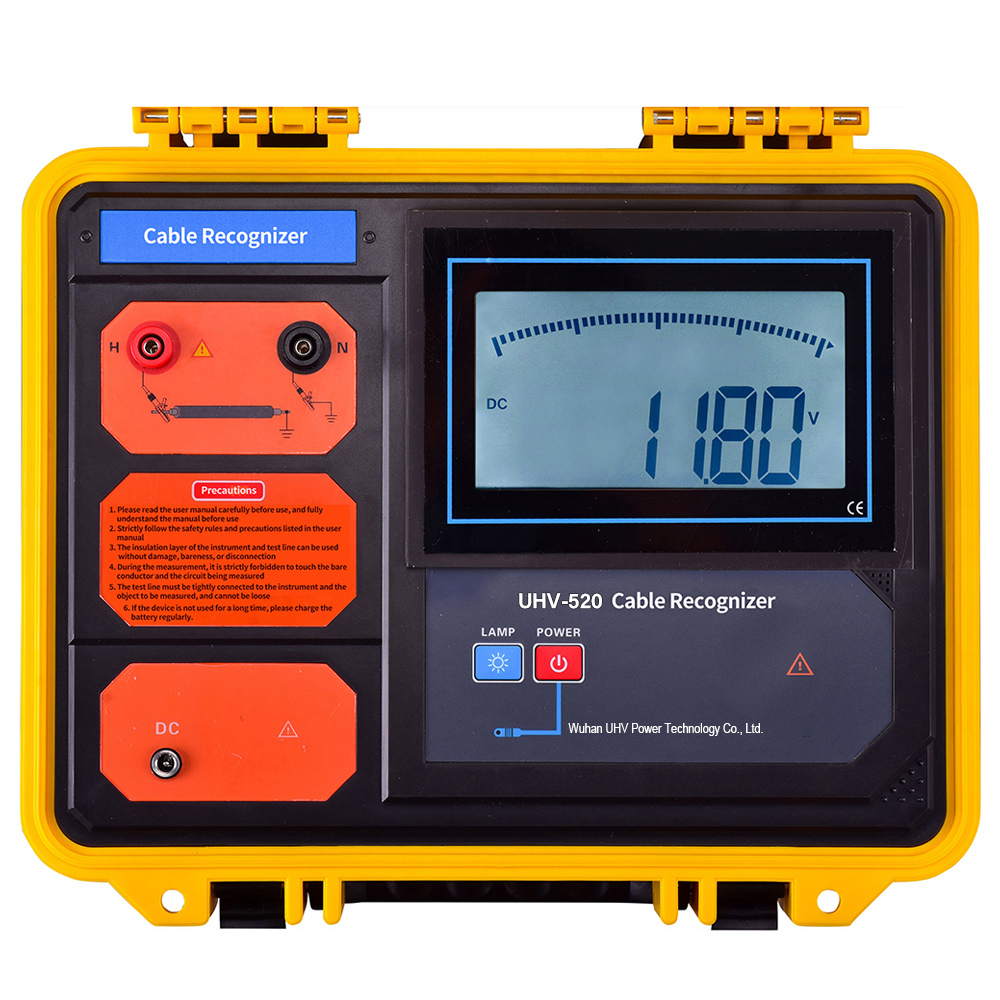
The instrument system consists of a transmitter, a receiver, and a flexible current clamp.
 |  |
Product functions:
1. Accurate cable identification — Locating the designated target cable among a group of multiple cables is its core function.
2. Pulse-coded signal identification — The transmitter generates a special pulse-coded current to the target cable, and the receiver determines whether it is the target cable by identifying this signal.
3. Target / non-target cable differentiation — The receiver uses color dynamic indication: target cable shows green clockwise dynamic indication, while non-target cables show red counterclockwise dynamic indication.
4. Signal strength display — The color dynamic raster displays the strength of the identification signal, assisting in judging the detection status.
5. AC voltage measurement — The receiver can also measure AC voltage, with a range of 0.01 to 600 V AC and accuracy of ±1% ± 1 digit.
6. Flexible current clamp detection — Uses a Rogowski flexible coil that can be wrapped around thicker or irregularly shaped cables to detect pulse current.
7. Rapid on-site testing — Both transmitter and receiver are powered by lithium batteries, providing approximately 8 hours of continuous operation on a full charge.
Product Characteristics:
1、Integrated Transmitter Design: The transmitter is housed in a specially designed, integrated toolbox-style enclosure. It is injection-molded using polypropylene plastic reinforced with new composite filling materials. This construction results in low density while offering superior strength, rigidity, hardness, wear resistance, heat resistance, and insulation performance.
2、Flexible Current Clamp: The flexible current clamp utilizes a Rogowski coil with excellent transient tracking capability. It can quickly and accurately identify the pulse-coded current generated by the transmitter, making it ideal for use with thick cables or conductors with irregular shapes.
Technical parameters:
Base conditions and working conditions
| Amount of influence | Benchmark conditions | The working conditions | note |
| Suhu lingkungan | 23℃±1℃ | -10℃~40℃ | / |
| Wet environment crossing | 40%~60% | <80% | / |
| Voltage frequency under test | 50Hz±1Hz | 10Hz~1000Hz | / |
| Receiver operating voltage | 7.4V±0.5V | 7.4V±1V | / |
| Transmitter operating voltage | 11.1V±0.5V | 11.1V±1.5V | / |
| External electric field and magnetic field | Should be avoided | ||
| Position of cable under test | The cable under test is located at the approximate geometric center of the flexible coil |
Transmitter specification
| Can work | Generating pulse coded current signal;Display remaining battery voltage |
| Electrical source | 11.1v large-capacity rechargeable lithium battery, which works for about 8 hours on full charge |
| Pulse voltage | 500V |
| Pulse current | Maximum 30A (depending on the circuit resistance) |
| Pulse frequency | 1 times per second |
| The pulse width | 2ms |
| Suhu kerja | -10℃~40℃ |
| Kondisi penyimpanan | -20℃~50℃,≤95%RH, No condensation |
| ukuran | 320mm×275mm×145mm |
| LCDsize | 128mm×75mm |
| LCDAccording to the domain | 124mm×67mm |
| Transmitter mass | 2,5kg |
| The total quality | 3.3 kg(Contains the receiver) |
Receiver specification
| fungsi | Identify and decode pulse current signals;Ac voltage measurement |
| Catu daya | 7.4v large capacity rechargeable lithium battery, USB charging interface, full charge continuously working for about 8 jam |
| Nilai saat ini | about 180mA max |
| Mode tampilan | 3.5 "true color LCD display, color electronic dial indicator |
| Cable identification successful | Green grating clockwise dynamic indicator |
| Non-target cable | Red grating counterclockwise dynamic indication |
| Receiver size | 207mm×101mm×45mm |
| Flexible coil | It is about 630mm in length and 6mm or 12.5mm in diameter |
| Coil diameter | φ200mm |
| Detection range | Coil loop resistance can be detected to 0 Ω ~ 2 k Ω pulse signal;When detecting circuit resistance for the 2 k Ω, need to ensure the transmitter battery for more than 10v |
| Rentang tegangan | AC 0.01V~600V(50Hz/60Hz) |
| Akurasi tegangan | ±1%±1dgt |
| Identification signal | Color grating dynamic display of signal strength |
| Detection rate | About 1 time/second |
| The battery voltage | When the battery voltage is lower than 6.5V, the battery voltage depression symbol is displayed to remind the battery to charge |
| Operating temperature and humidity | -10℃~40℃;80%RhThe following |
| Storage temperature and humidity | -10℃~50℃,≤95%RH, No condensation |
| Receiver mass | 370g(with battery) |
| Current clamp mass | 172g |
AplikasiScenarios
Substation and distribution room maintenance
Used to confirm the target cable when there are a large number of cables on site, labels are unclear, or the as-built drawings are inconsistent with the actual conditions.
Cable trenches and cable tunnels
Suitable for locations where cables are laid in concentrated areas. Each cable can be tested individually to determine which one is the target cable.
Cable relocation projects
During construction work such as road widening, subway construction, or utility tunnel development, when underground cables need to be relocated or removed, the target cable can be confirmed first.
Old cable removal
Used to confirm decommissioned cables during retrofitting of old substations, factories, and other facilities, reducing the risk of mistakenly cutting live or in-service cables.
Cable fault maintenance
After the fault location has been determined using cable fault locating equipment, the specific cable can be further confirmed to facilitate subsequent excavation and repair work.
Power plants and industrial enterprises
Used for equipment retrofitting, outage maintenance, line upgrades, and organization of legacy cable records.
Cable construction and acceptance
Can be used to confirm the correspondence between cable ends at both sides, helping construction personnel verify cable numbers and actual routing.
FAQ about Cable Identification Instrument
Q: How does it identify the target cable?
A: The device applies a specific pulse-coded signal to the target cable through the transmitter. The receiver uses a flexible current clamp to detect this signal, thereby determining whether the cable currently being tested is the target cable.
Q: Can it still identify the cable when there are many cables?
A: Yes. The device is designed specifically to locate the target cable among multiple cables. On site, each cable can be tested one by one according to the cable arrangement, and the target cable can be confirmed at the end.
Q: Why is it necessary to use the transmitter and receiver together?
A: Because the device needs to establish a clear correspondence between the target cable, the identification signal, and the receiver. This prevents misjudgment that may occur when relying solely on ordinary current or voltage measurements.